George Giokas
Portfolio:
www.georgegiokas.com
Contact Information:
- ggiokas.dev@gmail.com
I’m a video game programmer specialising in Unreal Engine and C++. I have a strong interest in gameplay systems, tools, and moment-to-moment player experience.
Over the last few years I’ve been studying game development at the Academy of Interactive Entertainment. During this time, I’ve worked on projects like DoorCrash, a team project where I helped design and implement core systems such as physics-based vehicle mechanics, quest logic, and driving/pedestrian behaviours, and a physics-driven bullet impact & procedural animation showcase plugin.
For me, game development is about creating experiences that feel responsive, readable, and interactive. I enjoy working closely with artists and designers, iterating quickly, and using player feedback to polish features.
Skills & Tools
- Programming: C++, Blueprint (Unreal Engine)
- Engine: Unreal Engine
- Tools: Visual Studio, version control (Git, Perforce)
- Focus areas: Gameplay programming, modular systems, tools/UX for designers
- Soft Skills: Communication, project management, teamwork, problem-solving, time management.
DoorCrash Project
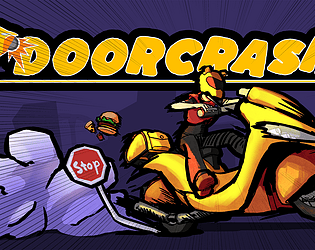
DoorCrash is a single-player arcade food delivery game where you play as a delivery driver racing across the city to deliver orders on time and pay your rent.
As Lead Programmer, I've been responsible for designing and implementing core gameplay systems including:
- Physics Based Vehicle simulation - responsive, semi-realistic handling that still has that arcade feel
- Dynamic, Scalable quest system - UX-friendly order generation, tracking and progression that's easy to extend
- Advanced mass AI - crowds of vehicles and pedestrians using efficient behaviors to keep the city feeling alive.
- User-friendly UI & navigation - controller and keyboard friendly menus, clean UX for settings and key binds.
DoorCrash download page!
Physics Project
Physics-Driven Bullet Impact & Procedural Animation Showcase
This project is a technical sandbox focused on realistic bullet impacts and procedural hit reactions for AI characters in Unreal Engine 5.
Instead of playing the same canned “hit” animations, enemies in this prototype react using a blend of skeletal physics, procedural animations, and data-driven gameplay:
-
Bullets are traced from the player’s camera, so shots land exactly where you aim.
-
Each impact checks which body part was hit, which weapon fired, and how far away the shot was.
-
Damage, knockback strength, and reaction intensity are all pulled from easy-to-edit data tables, so behavior can be tuned without touching code.
-
Hits drive a partial ragdoll state: bodies wobble, twist, and recover over time using physics and curves, rather than pre-baked animation clips.
-
When health runs out, enemies smoothly transition into a full ragdoll using the same underlying system.
What this project showcases
-
Procedural hit reactions:
Physics-based flinches and knockbacks that depend on weapon type, hit location, and direction of fire. -
Data-driven design:
All damage, impulse strength, and per-bone behaviour are controlled through data tables and curves, making it fast and painless to tweak balance and “feel”. -
Reusable setup:
Enemies inherit from a physics-ready template, and weapons plug in via simple IDs and configuration data, making the whole system easy to extend.
This is not a full game—it's a technical showcase of how far you can push procedural animation and physics-driven feedback for gunplay and AI reactions.